The Overhand Right?

Hey guys,

Would anyone care to give me a brief description of this and when it would be of main use?

From what I can gather it’s a regular right thrown, then a dropping motion of the hips (hard to explain) and in which circumstances would it be effective. Thanks

Hey LH,
tHis punch is commonly used with an opponent witha high guard or as a counterpunch.
My understanding of the overhand is that where the straight right is thrown long an directly out, the overhand is a shorter punch, which may involve “loading up.”
From my understanding the hand is drawn bac slightly, then released and the elbow is raised.
This means the arm will be thrown from a different loaction on the shoulder (higher,)

Does that help at all???

I thought not…

Thats great, more than I knew anyway. Lennox Lewis throws them a bit, and I was told after sparring a week back that I could have countered his straight rights with an over hand.

Yeah tall fighters may find them advantageous, Gerald McClellan used to commonly use a combonation that went: Jab-Right Straight-Right Overhand and it was devastating.

Works well over a jab. In my gym we often have chase where one person can throw whatever they want and the other only defend with jabs.

To begin with being the defender SUCKS but after a while you find a lot of ways to use a jab and the attacker needs to think a lot more to get in - in that case an overhand right seems to work for me (if I’m attacking).

When you begin to use it the jab is a brilliant form of defence. Triple is and slide to the side and your gone! I love doing that!

Yeah overhand right is perfect for going over jabs, it’s even better after firing a left uppercut. Left uppercut overhand right is devostating, the uppercut breaks the guard and puts you in the perfect position without having to load up anymore to get great power behind the punch.

It sort of acts like a corkscrew motion to put it best, where your elbow shoots out so it has a slight loop to it allowing you to put more shoulder and hip into the punch. It’s one of my favourite punches. Try throwing it when you can predict the jab coming throw it at the same time, when you get it correct the corkscrew motion knocks their jab down and out the way and you can land cleanly anywhere on their right side of their face.

Are you talking about an overhand cross,incredibly effective punch,you can catch them as they peek a boo,and it lands with big time power

and all this time i thought that everyone hated this punch…i use it and am constantly chastised about it by trainers that hate it…sigh

Gotta be tall and fast imo!!!

am tall but funny thing everyone that tells me not to throw it, also says only short fighters should use it…all i know is it works for me when i get to close for a cross

In the old days this was called the right cross, because it “crossed” over an opponent’s jab. You slip inside his jab and throw a right hook to his chin. Tall fighters have an advantage there, maybe, but an opponent has to jab up at a taller guy, making the punch harder to land unless you create angles. Many shorter fighters have had tremendous success with this punch because their opponents tend to jab down at them, leaving themselves vulnerable to this punch as they lean into it.

I thought it was a loop shot around and over the top of an extended arm from the outside position.
MAybe that was called the bolo shot i think ,different shot.
I like it anyway, cause the arm covers the intent of the shot and so it can be a ko shot from seemingly out of nowhere.
Ive used it against taller opponents too. that have a long jab that they made the mistake of holding out there too long for control.
You can even switchfeet under neath that arm by going forwards and under with your head taken there by your rear leg heading out on a 45 angle as you pull the left foot back around into stance as you land the right over hand bomb over his left arm. (its safe to switch there in that spot,actually gives you a power advantage).

Now that Ive figured out how to use the film option on my camera,Im thinking I should take advantage of my You Tube acount to go over the basic punches

Hi Lord Harris,
You asked:
Would anyone care to give me a brief description of this and when it would be of main use?

The overhand right (or left) is a rear-handed slightly-hooking, downward convex-arc punch normally used against a matching-stance opponent (i.e. orthodox vs orthodox or southpaw vs southpaw) that is mainly intended as a simultaneous counter over an opponent’s left (or right) jab.

More descriptively, it is thrown like this from a left lead (i.e. orthodox) stance:

  1. “Trigger step” 30 to 45 degrees to the left with your left foot to open up the hips and generate momemtum.
  2. “Hip-whip” (as you would, for example, when you swing a baseball bat) the right hip towards your opponent to recoil the right (striking side) shoulder and put hip & leg torque into the punch.
  3. Raise your right elbow slightly above your right shoulder and turn your right fist at a 30 to 90 degree position (you will naturally adjust your fist position according to the relative position of your opponent’s left arm as you counter) with the right palm facing away from you.
  4. As you do this, lean/angle your body to the left (your weight distribution now primarily shifting to/over the lead left foot) and “shoulder-whip” your right arm “rainbow-arching” it over your opponent’s left arm as you shoot it to and through the left side of your opponent’s jawline.
  5. Follow-through with your shot as you strike through the jawline target. Simultaneously, let your rear right leg naturally follow-through, “gliding” forward (right knee slightly bent naturally) as your punch makes contact.
  6. Retract your punching hand back in a “pulling” arc back to your guard position.
  7. As you are doing the above, be sure to have your chin tucked and left hand up protecting the left side of your head as you are throwing your overhand punch.

This punch is a versatile one, as all boxing punches are, that can be used to discombobulate an opponent with its non-traditional oblique trajectory. Besides the aforementioned, you can use it to split an opponent’s high guard and nail him down the middle. It is also a potent punch that a smaller man can effectively employ against a larger/taller adversary, especially at close range. Furthermore, it is an effective punch to use in combination with the other more “traditional” boxing blows to confuse and overwhelm opponents who are used to defending the standard lines of attack.

Anyway, I hope this helps you out. Take care…

arguello uses the left upper + overhand right combo pretty well. His right really comes crashing down.

thats interesting Sp. There is something you left out though. The most important thing in whipping punches like the right hook and the left hook is - not suprisingly- the actual whip of it. It seems simple enough. However rarely does anyone actually seem to know what this even is or for that matter how to actually execute it. The motion involved in punches require absolute precision in order to preform correctly and the room for error is very tiny. Even the slightest error in the execution of a punch can take away all of the power like a house of cards falling in on itself because of one misaligned section. Anyway to explain how the whip part of a punch works we’ll take a look at the basic physics of it.
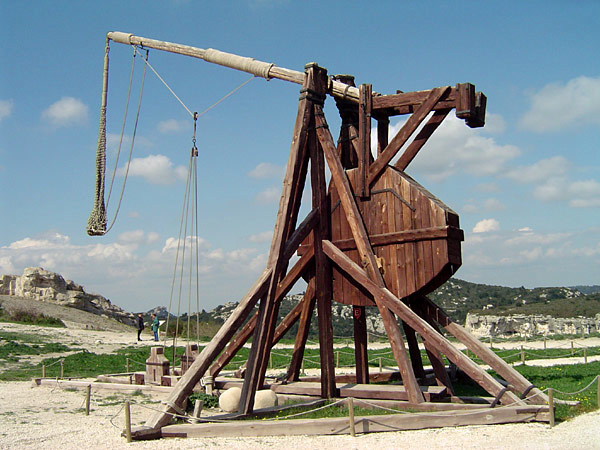
You’ve probably seen one of these before. Its called a Trebuchet. A very powerful catapult-like weapon (though much more powerful than a catapult) capable of launching extremely heavy projectiles for great distances. The concept is simple. A great amount of force is generated at one end and the resulting energy that is created in this movement is sent to the other end imbuing that side with this tremendous energy.

In the case of the Trebuchet this force is generated by a massive weight which is dropped on one end. The energy created here causes the other end which is lighter to be, in essence, injected with that energy. This end becomes packed to the brim with absolutely tremendous amounts of energy. We can see this process vividly in this illustraion here:
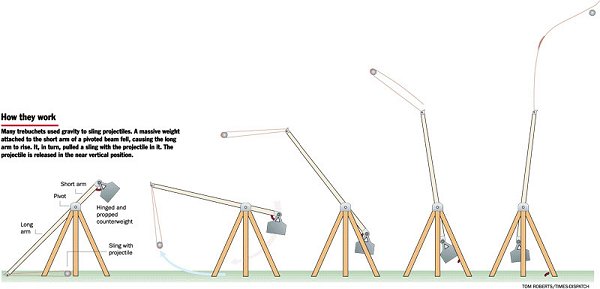
Now, take a look at that picture. Look closely. Is that not very much like a punch? Look again you may not see it at first. The main part of the trebuchet is similar to the body; the dropping of the weight on one end represents the turning of the hips; the sling ultimately represents the arm; the projectile at the very end of the sling - your fist. If it seems that the Trebuchet is very similar to say, a left or right hook, its because it most certainly is. In fact it is exactly analogous to these types of punches.

So when we speak of “whipping” punches we are ultimately referring to these phyciscal principles. Its actually quite simple.

  1. the force generated at the turning of the hips -> 2. sends lots of energy into into your arm -> which 3. ultimately goes into your fist.

Notice how this process is broken up into segements opposed to being one single movement. The force generated at the hips must come first. The reason it must come first is because if there is no energy created here then there will be none to send into the arm. Thus because of this there is always a slight delay between the turn of the hips and the slinging of the arm. That force must be created fully before it can be sent into the arm. You must wait for the energy to fully develop and once at its peak, send your arm on its way. If you send the arm along with the body as it turns you will not reach full power in your punch.

Once sent to the arm, the energy of the body is then condensed into the small area of the fist. Thus the fist becomes literally packed to brim with this termendous energy. The weight of the body inside of your fist; a very scary kind of power, when one stops to think.

However most fighters never end up able to pack their fists with that kind of energy. Their punching techniques are not harmonius with these basic principles and thus they can never achieve these levels of power. Specifically, what I have outlined here is only one part of how to execute a punch: the “whip” portion. There is more to it. But this is the most critical peice of information when one speaks of whipping punches.

Have you ever seen Jack Dempsey punch? He is like a human Trebuchet. Something extra to think about. Why is he able to generate such great forces in his punches. What is he doing in his stance?

Also it should be noted that the straight right does not involve a whipping motion and is very different in principle to the left hook and right hook.

Hi Thomas,
Great post! Hey, I hope you don’t mind me borrowing your analogies and examples for future reference. They explain certain things nicely, especially in written form.

Thanks and take care…

Its all for free. All I ask is that any information I have be considered in such a way so as to build upon, add, or fix. Don’t just sit there and nod, attack it from every angle. Ultimately thats the only way to really understand something anyway.